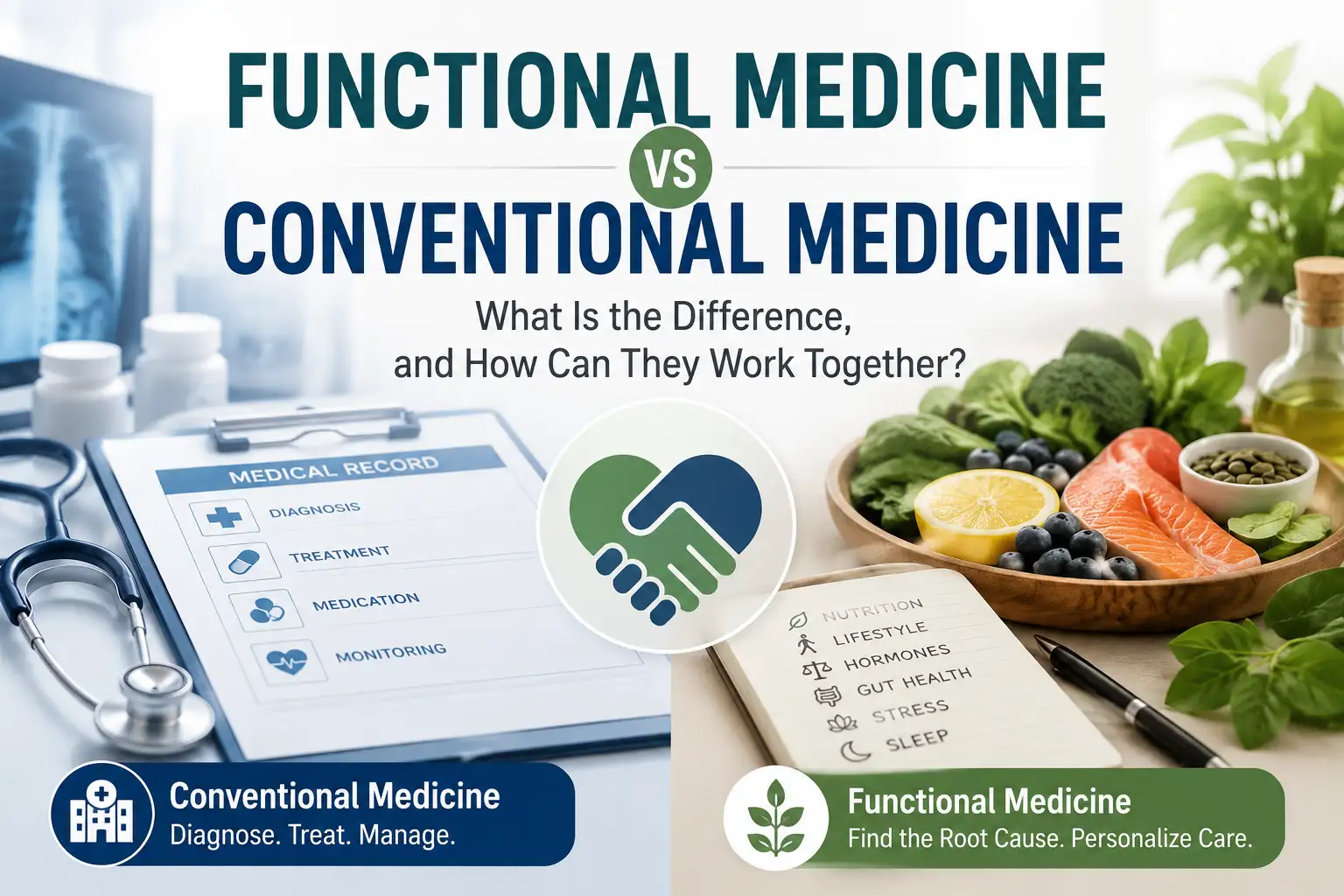
When people compare functional medicine vs conventional medicine, it can sound as though they have to choose one side. That is not necessarily the case. Conventional medicine provides established tools for diagnosing, preventing, monitoring, and treating disease, while functional medicine places additional emphasis on understanding how factors such as nutrition, lifestyle, environment, genetics, and interconnected body systems may contribute to a person’s health concerns.
At M.F. Family Health NP P.C in Staten Island, we take a similar combined approach. Dr. Marina Fest, DNP, offers primary care alongside functional medicine and uses conventional medical tools together with a broader evaluation of factors that may be influencing a patient’s health. Our functional medicine service specifically considers areas such as hormones, gut health, thyroid function, adrenal function, nutrition, lifestyle, environment, and biology when clinically appropriate.
What Is the Main Difference Between Functional Medicine and Conventional Medicine?
The main difference is usually where the clinical emphasis is placed, not whether one approach is “real medicine” and the other is not.
Conventional medicine typically begins with your symptoms, medical history, physical examination, established diagnostic criteria, and appropriate testing. Once a condition is identified, treatment may include medication, lifestyle changes, monitoring, procedures, specialist referral, or other evidence-based care.
Functional medicine uses many of those same clinical tools but places greater emphasis on looking for patterns among multiple factors that may be contributing to a chronic or complex health concern. Functional medicine is a patient-centered approach that considers medical history along with genetic, lifestyle, nutritional, environmental, and other factors that may influence chronic disease.
That distinction matters because conventional medicine is not limited to treating symptoms. Primary care also includes prevention, screening, disease management, medication management, lifestyle counseling, and long-term monitoring. Functional medicine adds another framework for examining how different influences may fit together.
Functional Medicine vs Conventional Medicine at a Glance
| Area | Conventional Medicine | Functional Medicine |
| Primary focus | Diagnose, prevent, monitor, and treat health conditions | Examine contributing factors and patterns across the whole patient |
| Assessment | History, examination, standard testing, established clinical criteria | History and clinical testing plus deeper attention to lifestyle, nutrition, environment, and interconnected systems |
| Treatment tools | Medication, lifestyle changes, procedures, monitoring, referrals | May combine conventional treatment with individualized lifestyle, nutrition, and other appropriate interventions |
| Best fit | Preventive care, acute illness, diagnosed disease, chronic disease management, and medical monitoring | Often used as an additional framework for chronic, persistent, or multifactorial concerns |
| Relationship between them | Forms the foundation of modern medical care | Can complement conventional medical evaluation and treatment |
The most useful question is therefore not necessarily, “Which one is better?” A better question is, “What type of evaluation and care does this particular health problem require?”
What Does Conventional Medicine Do Well?
Conventional medicine is especially important when a health problem requires a clear diagnosis, established testing, medication, ongoing disease monitoring, specialist care, or urgent treatment.
For example, if you have high blood pressure, your care should not stop at asking why stress, sleep, diet, or other factors may be influencing your readings. Blood pressure itself needs to be measured correctly, monitored over time, and treated according to your individual risk and clinical situation.
The same principle applies to conditions such as diabetes, asthma, infections, thyroid disease, cardiovascular concerns, and many other medical problems. Lifestyle factors can matter, but they do not eliminate the need for appropriate diagnosis or treatment.
At our Staten Island practice, primary care includes preventative care and ongoing management of chronic health concerns. We can monitor changes over time, review medications, order appropriate testing, and coordinate specialist care when it is needed.
What Does Functional Medicine Add to the Evaluation?
Functional medicine becomes especially useful as a way of organizing a more detailed clinical picture.
Imagine that you have persistent fatigue. Fatigue is a symptom, not a diagnosis. Simply labeling it as fatigue does not explain why it is happening.
Depending on your individual situation, a clinician may need to consider factors such as:
- Sleep quality
- Nutrition
- Stress
- Medication effects
- Thyroid function
- Hormonal factors
- Anemia or nutrient deficiencies
- Metabolic health
- Mental health
- Other underlying medical conditions
Functional medicine encourages the clinician to examine how relevant pieces of that picture may interact rather than treating each complaint as completely isolated.
That does not mean every patient needs extensive functional testing. Testing should answer a meaningful clinical question. More testing is not automatically better care.
At our practice, Dr. Fest’s functional medicine approach may include evaluation of hormones, gut health, thyroid function, and adrenal function when those areas are relevant to the patient’s symptoms and health history. Our functional medicine model also considers nutrition, lifestyle, environment, and biology as part of the overall picture.
Can Functional Medicine and Conventional Medicine Be Used Together?
Yes. In many situations, using them together makes more sense than treating them as competing systems.
Cleveland Clinic specifically states that its functional medicine providers collaborate with conventional medicine clinicians rather than replacing them. Its program combines the functional medicine model with established medical care for chronic disease.
A combined approach might look like this:
You have a diagnosed medical condition that requires standard monitoring or medication. Conventional care addresses the diagnosis and medically necessary treatment.
At the same time, you and your clinician examine whether sleep, nutrition, physical activity, stress, weight, environmental exposures, or other relevant factors are influencing how you feel or how well the condition is managed.
Functional medicine can therefore broaden the clinical conversation without requiring you to abandon appropriate conventional treatment.
Does Functional Medicine Always Mean Natural Treatment?
No. Functional medicine is sometimes described online as “natural medicine,” but that description is too narrow. The defining feature is the broader, systems-based and personalized evaluation, not the rejection of medications or conventional medical tools.
An integrative approach can use conventional medical tools alongside natural protocols when appropriate. Dr. Fest can order and monitor laboratory testing and incorporate those findings into an individualized care plan.
A supplement, dietary change, medication, or other intervention should still have a clear reason for being used. “Natural” does not automatically mean necessary, effective, or appropriate for every patient.
When Might a Functional Medicine Perspective Be Helpful?
A functional medicine perspective may be worth discussing when symptoms are persistent, when several health concerns overlap, or when lifestyle and metabolic factors appear relevant to an existing condition.
For example, a patient may want a broader evaluation when dealing with persistent fatigue, changes in weight, digestive concerns, hormonal symptoms, or other ongoing patterns.
The important part is to avoid assuming the cause before the evaluation begins.
Fatigue does not automatically mean an adrenal problem. Weight changes do not automatically mean a hormonal disorder. Digestive symptoms do not automatically prove a particular food sensitivity.
A proper evaluation starts with your symptoms and history, then uses appropriate medical reasoning and testing to determine what deserves further investigation.
Why Your Primary Care History Still Matters
Functional medicine works best when it is connected to your broader medical care rather than separated from it.
Your blood pressure, medication list, previous diagnoses, family history, laboratory results, allergies, mental health, sleep, nutrition, and lifestyle can all affect how a new symptom should be interpreted.
That continuity is one reason we offer primary care and functional medicine within the same Staten Island practice. Dr. Marina Fest sees patients age 14 and older, allowing the clinical picture to remain connected as different health needs develop over time.
The Best Approach Depends on What Your Body Actually Needs
The debate over functional medicine vs conventional medicine becomes much simpler when the focus returns to the patient.
You may need conventional medical testing and treatment. You may also benefit from a closer look at nutrition, sleep, stress, hormones, lifestyle, or other contributing factors. In many cases, these are not opposing choices.
At M.F. Family Health NP P.C, our goal is to understand the complete clinical picture before deciding what should happen next. If you have an ongoing concern and want to discuss whether a functional medicine evaluation fits your situation, you can schedule a visit with Dr. Marina Fest at our Staten Island office.
Frequently Asked Questions
Is functional medicine the same as holistic medicine?
Not exactly. Functional medicine is a systems-based, individualized model that looks at potential contributors to illness across areas such as lifestyle, nutrition, environment, genetics, and physiology. “Holistic” is a broader term that can describe many different approaches to whole-person care.
Can functional medicine replace my primary care provider?
Functional medicine should not automatically replace primary care. Preventive screening, medication management, diagnosis, chronic disease monitoring, referrals, and other conventional medical services may still be necessary. Functional medicine works collaboratively with conventional medicine rather than replacing it.
Does functional medicine require special laboratory testing?
Not every patient requires the same testing. Testing should be selected according to symptoms, medical history, examination findings, and the clinical question being investigated. At Dr. Marina Fest’s practice, functional medicine services can include testing related to hormones, gut health, thyroid function, and adrenal function when appropriate.
Is functional medicine only for chronic conditions?
Functional medicine is commonly discussed in relation to chronic and complex health concerns because it emphasizes contributing factors and long-term patterns. Conventional medical care remains essential when acute illness, established disease, preventive care, medication, or urgent evaluation is needed.
Where can I get functional medicine care in Staten Island?
Dr. Marina Fest, DNP, provides functional medicine services through M.F. Family Health NP P.C, located at 2627 Hylan Blvd D2, Staten Island, NY 10306. The practice also provides primary care, allowing functional and conventional medical considerations to remain connected within the patient’s overall care.