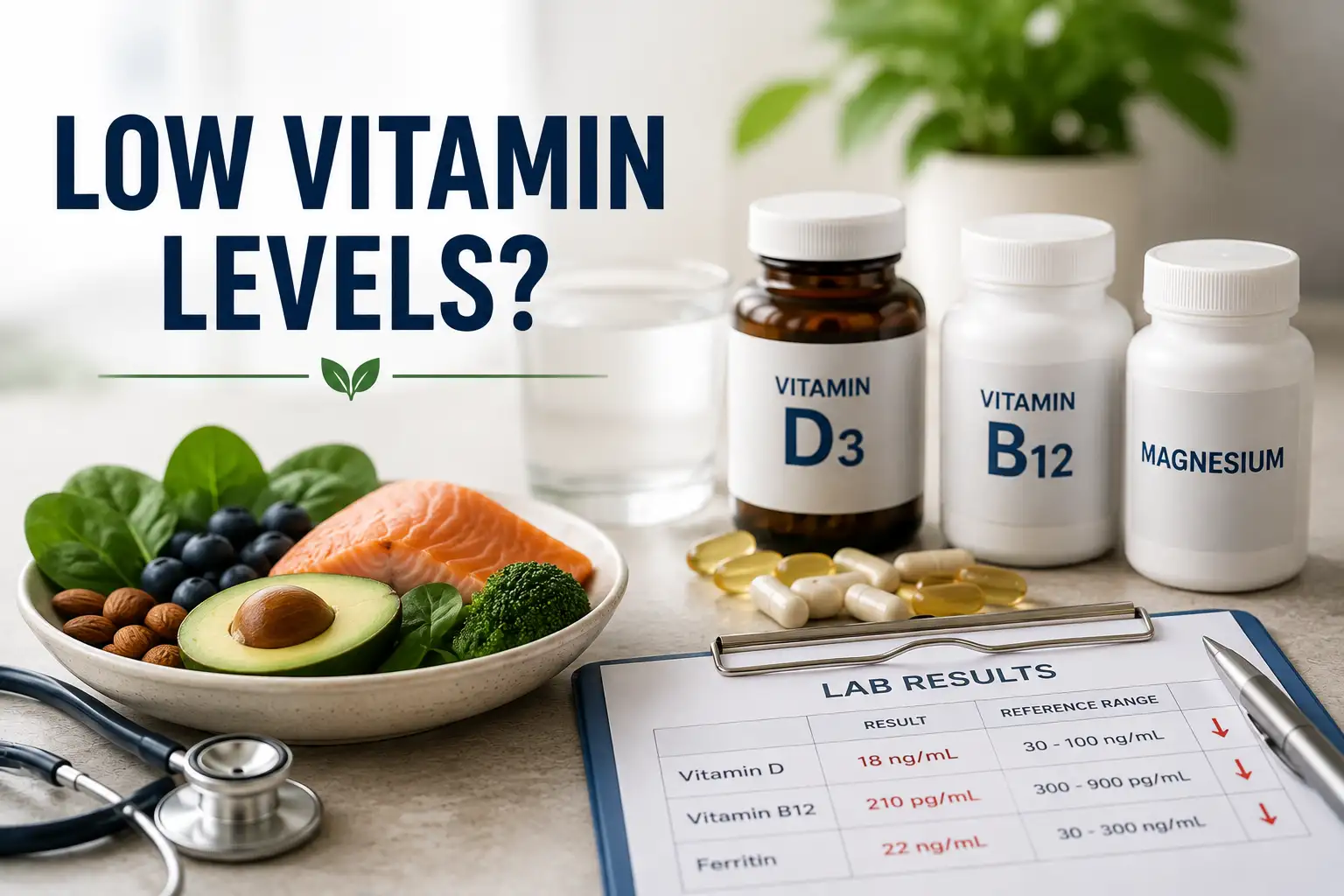
When vitamin levels remain low even though you are taking supplements, the problem is not always that you simply need a higher dose. Your body has to absorb the nutrient, process it correctly, and maintain enough of it to change the laboratory value being measured. Medications, digestive conditions, previous surgery, the form of a vitamin, and even how a lab test is interpreted can influence the result.
At M.F. Family Health NP P.C in Staten Island, we approach persistent nutrient concerns by looking beyond the supplement bottle. Dr. Marina Fest, DNP, can review symptoms, medical history, medications, nutrition, and laboratory findings together as part of her functional medicine approach. The practice can also order and monitor laboratory testing when it is clinically appropriate.
Why Might a Vitamin Level Stay Low Even When You Take It Every Day?
A supplement only provides the nutrient. It does not guarantee that enough of that nutrient will reach your bloodstream or that the laboratory marker will respond as expected.
Several different steps have to work:
- You need an appropriate amount of the nutrient.
- Your digestive system has to absorb it.
- The body may need to transport, store, or convert it.
- Medications or health conditions must not substantially interfere with those processes.
- Enough time has to pass for the relevant laboratory marker to change.
- The laboratory test itself has to accurately reflect the nutrient status being evaluated.
That is why persistent low levels deserve evaluation rather than automatic dose escalation.
The Supplement Dose May Not Match Your Actual Need
One of the first questions is simple: how much of the nutrient are you actually getting?
A multivitamin may contain a vitamin, but that does not mean it contains an amount appropriate for correcting an established deficiency. On the other hand, taking increasingly large doses without understanding the reason for the low level is not a good solution either.
Individual needs can differ according to factors such as:
- Baseline nutrient status
- Diet
- Age
- Medical conditions
- Medications
- Previous gastrointestinal surgery
- Body composition
- The specific vitamin being measured
Vitamin D provides a useful example. NIH data show that both vitamin D2 and D3 can raise blood 25-hydroxyvitamin D levels, but vitamin D3 generally raises the level more effectively and maintains the increase longer.
The right question is therefore not simply, “Am I taking a vitamin?” It is, “Is this the right nutrient, form, amount, and plan for the reason my level is low?”
Your Digestive System May Not Be Absorbing the Vitamin Normally
You can swallow a supplement every day and still have difficulty absorbing enough of it. This becomes especially relevant for nutrients whose absorption depends on particular digestive processes.
For example, vitamin D is fat soluble, so adequate intestinal fat absorption contributes to its absorption. Conditions associated with fat malabsorption, including celiac disease, Crohn’s disease, ulcerative colitis, cystic fibrosis, and some liver diseases, can increase the risk of low vitamin D status.
Vitamin B12 has a different absorption pathway. Persistent B12 deficiency can occur when a person has difficulty absorbing the vitamin because of conditions such as pernicious anemia, gastrointestinal surgery, or other causes of impaired absorption.
This is one reason simply increasing supplements can miss the bigger issue. If absorption is impaired, the underlying reason deserves attention.
Could Your Medications Be Affecting Vitamin Levels?
Yes. Certain medications can influence how particular nutrients are absorbed or maintained. A well-established example is vitamin B12.
The NIH Office of Dietary Supplements notes that metformin can reduce vitamin B12 absorption and lower serum B12 concentrations. Gastric acid suppressing medications can also interfere with the absorption of food-bound B12 because stomach acid helps release B12 from food.
Other medication-nutrient relationships exist as well. For example, the weight-loss medication orlistat can reduce vitamin D absorption because it reduces fat absorption.
This does not mean you should stop a prescription medication because a vitamin level is low.
Instead, your clinician needs to know everything you take, including:
- Prescription medications
- Over-the-counter medications
- Vitamins
- Minerals
- Herbal products
- Other dietary supplements
That information can help determine whether a medication, supplement interaction, or another factor belongs in the clinical picture.
Your Body May Process the Vitamin Differently After Absorption
Absorption is only part of nutrient metabolism. Vitamin D again provides a clear example. Vitamin D obtained from food, supplements, or skin production is not immediately in its final active form. It undergoes processing first in the liver and then primarily in the kidneys.
Body composition may also influence measured vitamin D levels. People with obesity commonly have lower circulating 25-hydroxyvitamin D levels, in part because more vitamin D can be distributed into or sequestered in body fat. Some people with obesity may require higher vitamin D intakes to achieve circulating levels similar to people without obesity.
That does not mean weight automatically explains a low vitamin level. It means the same supplement can produce different laboratory responses in different patients.
Previous Stomach or Intestinal Surgery Can Change Nutrient Absorption
Your surgical history matters when nutrient levels do not improve as expected.
For example, gastric bypass surgery changes the normal route through parts of the gastrointestinal tract where nutrients are absorbed. NIH specifically identifies people who have undergone gastric bypass as being at increased risk for vitamin D deficiency. Gastrointestinal surgery can also contribute to vitamin B12 deficiency.
If you have had bariatric surgery or another gastrointestinal procedure, supplement requirements and monitoring may therefore be different from those of someone with normal gastrointestinal anatomy.
Is the Laboratory Result Always as Simple as “Low” or “Normal”?
No. Laboratory data require context.
Different nutrients are assessed using different biomarkers, and the result has to be interpreted according to what was actually measured.
Vitamin D illustrates this clearly. Serum 25-hydroxyvitamin D, or 25(OH)D, is the primary marker used to assess vitamin D status. Vitamin D test results can vary among laboratory assays, potentially producing values that are somewhat higher or lower depending on the testing method.
A single number therefore should not always be interpreted in isolation.
Your clinician may need to consider:
- The exact test performed
- Previous results
- Whether the level is changing over time
- Your supplement use
- Symptoms
- Diet
- Medical history
- Medications
- Related laboratory findings
The pattern often matters more than one isolated result.
What If the Supplement Is Treating the Number but Not the Cause?
This is where a broader evaluation becomes useful.
Suppose someone repeatedly has a low vitamin level. One approach would be to keep increasing supplementation. Another is to ask why maintaining that nutrient has been difficult in the first place.
Depending on the vitamin and the patient’s history, questions might include:
- Is dietary intake adequate?
- Is absorption impaired?
- Is a medication contributing?
- Has the patient had gastrointestinal surgery?
- Is another medical condition relevant?
- Is the supplement being taken consistently?
- Is the correct nutrient marker being monitored?
- Is the current formulation appropriate?
At our practice, this type of connected evaluation fits within functional medicine care, where Dr. Fest reviews laboratory findings alongside nutrition, lifestyle, symptoms, medications, and other relevant aspects of a patient’s physiology rather than relying on one number alone.
Should You Just Take More of the Vitamin?
Not without understanding what is happening.
“More” is not automatically better. Appropriate supplementation depends heavily on the nutrient, the degree of deficiency, your health conditions, your medications, and what your laboratory testing shows.
The safer approach is to determine:
what is low → why it may be low → whether supplementation is appropriate → what dose or form is appropriate → when and how it should be monitored
That sequence helps prevent supplement use from becoming guesswork.
It also matters because dietary supplements can interact with medications. NIH recommends discussing supplement use with healthcare professionals so that possible interactions and effects on nutrient absorption can be reviewed.
Persistent Low Vitamin Levels Need Context, Not Guessing
When vitamin levels remain low, the supplement itself is only one piece of the investigation.
A persistent low result can raise questions about dosage, nutrient form, gastrointestinal absorption, medications, previous surgery, body composition, metabolism, diet, and laboratory interpretation. Which of those factors matters depends on the nutrient and the individual patient.
At M.F. Family Health NP P.C, Dr. Marina Fest can connect your laboratory data with your symptoms, health history, medications, nutrition, and broader clinical picture. If you continue to have low nutrient levels despite supplementation, an individualized evaluation can help determine what deserves attention before you simply add more supplements.
Frequently Asked Questions
Why is my vitamin D still low even though I take a supplement?
Several factors can affect vitamin D levels, including the amount and form taken, fat absorption, gastrointestinal conditions, previous gastric bypass surgery, certain medications, and body composition. Vitamin D3 also generally raises serum 25-hydroxyvitamin D more effectively than vitamin D2.
Why can vitamin B12 remain low despite supplements?
Low B12 can be related to absorption problems, pernicious anemia, gastrointestinal surgery, dietary deficiency, or medications such as metformin. The underlying reason determines what type of management and monitoring is appropriate.
Can medications cause low vitamin levels?
Some can. Metformin can reduce vitamin B12 absorption, gastric acid suppressing medications can affect food-bound B12 absorption, and orlistat can reduce vitamin D absorption. Medication effects vary by nutrient, so your full medication and supplement list should be reviewed with your clinician.
Does a low vitamin level always mean I need a higher supplement dose?
No. A low result can have multiple explanations, including inadequate intake, impaired absorption, medication effects, medical conditions, or differences in laboratory measurement. Increasing a dose without understanding the reason may fail to solve the problem.
Where can I have persistent vitamin deficiencies evaluated in Staten Island?
Dr. Marina Fest, DNP, provides functional medicine care at M.F. Family Health NP P.C in Staten Island. Her functional medicine approach can incorporate symptoms, nutrition, medications, physiology, and laboratory monitoring when evaluating ongoing health concerns.