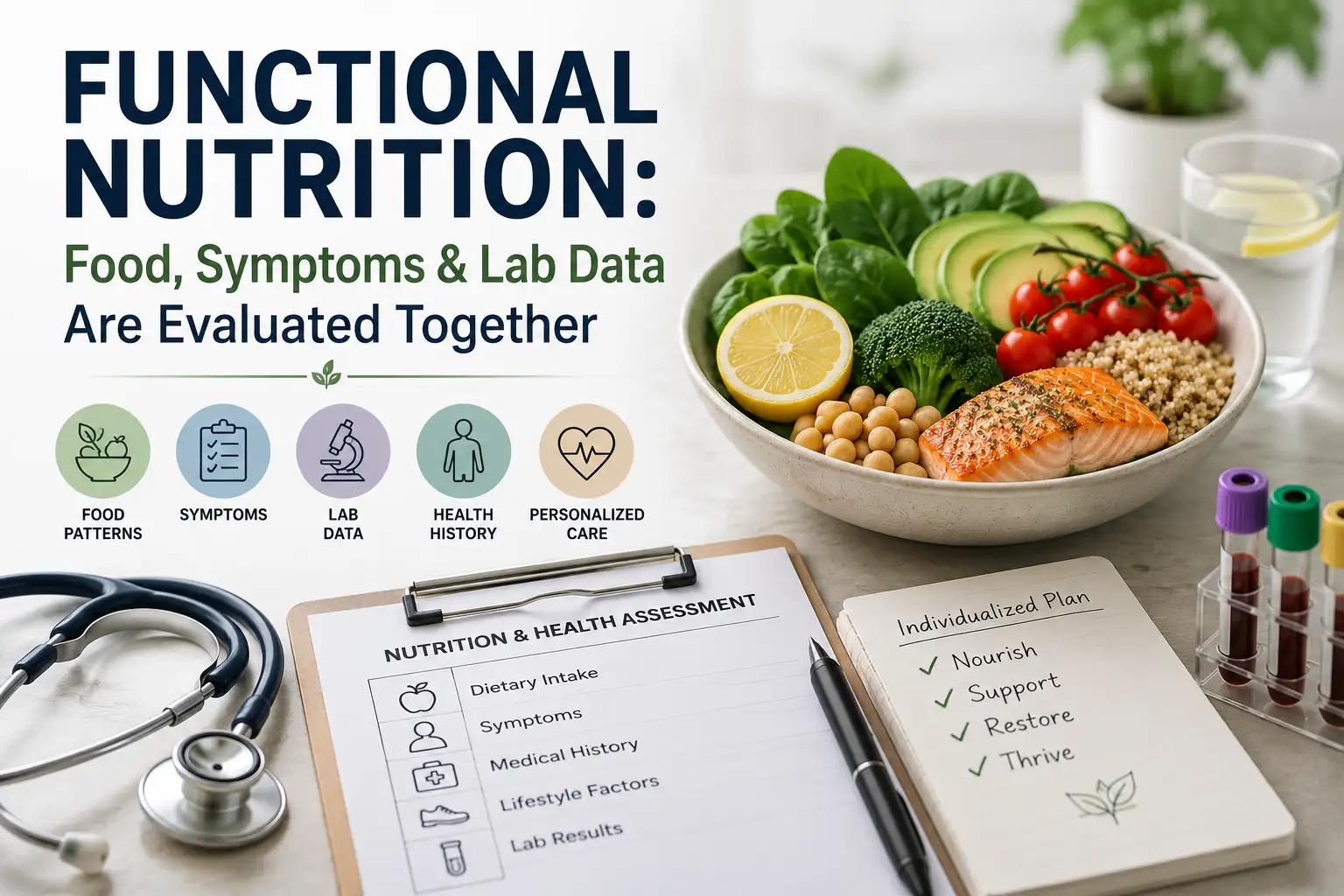
Functional nutrition looks at food as one part of a larger clinical picture. Instead of asking only whether you eat enough protein, vegetables, or calories, the approach considers how your diet relates to your symptoms, medical history, lifestyle, medications, digestion, metabolic health, and relevant laboratory findings.
At M.F. Family Health NP P.C in Staten Island, nutrition is one of the factors Dr. Marina Fest, DNP, considers within her broader functional medicine approach. Our functional medicine model looks at the interaction between nutrition, lifestyle, environment, biology, hormones, gut health, thyroid function, and other relevant systems rather than treating every complaint as an isolated issue.
What Does Functional Nutrition Mean?
Functional nutrition applies a personalized, whole-patient approach to nutrition. The goal is not simply to give everyone the same list of “healthy foods.” Instead, the clinician looks at what you eat alongside the health information that gives those dietary choices context.
That may include:
- Your usual eating pattern
- Changes in appetite
- Digestive symptoms
- Energy levels
- Weight changes
- Sleep
- Stress
- Existing medical conditions
- Medications and supplements
- Relevant laboratory results
- Your response to previous dietary changes
This broader approach is consistent with comprehensive nutritional assessment in clinical care. Nutritional status should not be judged from one test alone. A comprehensive assessment can include medical history, physical examination, dietary assessment, measurements, and diagnostic testing.
The important idea is simple: food data, symptom data, and laboratory data become more useful when they are interpreted together.
Why Doesn’t a Food List Tell the Whole Story?
Two people can eat similar diets and still have very different health concerns.
One person may tolerate a particular eating pattern well. Another may have a medical condition, medication, digestive problem, metabolic issue, allergy, or other factor that changes what needs to be evaluated.
Consider fatigue. A person who feels tired may assume that food is the problem and start eliminating carbohydrates, dairy, gluten, or other foods. But fatigue is nonspecific. Sleep problems, anemia, thyroid disorders, medication effects, stress, metabolic conditions, mental health concerns, and other medical issues can also contribute.
That is why we do not want nutrition recommendations to begin with a conclusion that has not been established.
The better sequence is:
symptoms → health history → diet → clinical evaluation → appropriate testing → interpretation → individualized plan
Food matters, but it should be interpreted in context.
How Are Food Patterns Evaluated?
A nutrition-focused evaluation begins by understanding what you actually eat and how that pattern fits into your life.
Rather than focusing on one meal or one “bad” food, a clinician may look for broader patterns involving:
- Meal frequency
- Protein intake
- Fiber-containing foods
- Fruits and vegetables
- Hydration
- Highly processed foods
- Alcohol
- Caffeine
- Meal timing
- Changes in appetite
- Foods associated with symptoms
- Dietary restrictions
- Supplement use
A nutritional history can also include appetite, digestive function, allergies, medical conditions, and other factors that influence nutrient intake or utilization.
The purpose is not to assign a moral value to your diet. It is to identify information that may help explain what is happening clinically.
How Are Symptoms Connected to Nutrition?
Symptoms provide context, but they do not automatically reveal the cause.
For example, a patient may report:
- Fatigue
- Bloating
- Constipation
- Changes in weight
- Difficulty concentrating
- Changes in appetite
- Sleep problems
- Changes in energy after meals
Those symptoms may justify looking more closely at nutrition, but the clinician still has to determine whether food is directly involved or whether another medical issue needs attention.
This distinction is especially important in functional medicine.
At our practice, Dr. Fest evaluates factors such as nutrition, hormones, gut health, thyroid function, lifestyle, environment, and biology when they are relevant to the patient’s symptoms.
A symptom is therefore a starting point for investigation, not proof that a particular food or nutrient is responsible.
What Role Does Lab Data Play in Functional Nutrition?
Laboratory data can add objective information, but lab results should not be interpreted in isolation.
There is no single blood test that can provide a complete assessment of nutritional status. Clinical nutritional assessment combines laboratory information with history, dietary intake, physical findings, and other relevant data.
Depending on your symptoms and medical history, a clinician may determine that certain laboratory studies are appropriate.
The specific tests will vary from patient to patient.
For example, a clinician evaluating fatigue may need a different set of information than one evaluating changes in blood sugar, digestive symptoms, or a suspected thyroid problem.
At M.F. Family Health NP P.C, Dr. Fest can order and monitor laboratory testing as part of functional medicine care. Her functional medicine services may also evaluate areas such as hormones, gut health, thyroid function, and adrenal function when clinically appropriate.
The key is that testing should answer a meaningful clinical question.
More laboratory testing does not automatically mean better care.
How Are Food, Symptoms, and Lab Results Put Together?
The useful part of functional nutrition is the relationship among the information. Imagine a patient reports persistent fatigue. Looking at only one part of the picture could lead to very different conclusions:
Food alone:
The patient may assume that eating differently will solve the problem.
Symptoms alone:
Fatigue tells us something is wrong, but not necessarily why.
Lab data alone:
A laboratory value may be normal, abnormal, or borderline, but it still needs clinical interpretation.
A more complete evaluation asks how these pieces relate.
What is the patient’s usual diet? Has appetite changed? Is sleep adequate? Are there gastrointestinal symptoms? Have weight or medications changed? Is there an existing condition that could explain the symptom? Do the laboratory findings support or weaken a particular explanation?
That creates a clinical pattern instead of a collection of disconnected observations.
Does Functional Nutrition Mean Eliminating Foods?
Not automatically. Elimination diets have become closely associated with functional health discussions online, but removing foods without a clear reason can make a diet unnecessarily restrictive.
A food should not be blamed simply because symptoms exist.
Dietary changes should be based on the patient’s history, symptoms, health needs, and clinical evaluation. When a particular food appears to be relevant, the next step should be deliberate rather than random.
This is also why “healthy eating” is not identical for every person. A dietary plan has to account for the patient’s broader medical situation.
How Is Functional Nutrition Different From a Standard Diet Plan?
A standard diet plan may begin with a general goal such as:
- Eat fewer calories
- Increase protein
- Increase vegetables
- Reduce processed foods
- Follow a predetermined meal plan
Those recommendations can still be useful.
Functional nutrition simply asks additional questions about why a particular strategy fits the individual patient.
For example, if someone is struggling with weight, we may need to understand more than calorie intake alone. At our practice, medical weight management begins with a clinical evaluation that may consider the patient’s health history, metabolism, and relevant hormonal factors before an individualized plan is developed.
Likewise, if thyroid-related symptoms are part of the picture, Dr. Fest’s functional medicine approach evaluates the thyroid within the context of other relevant factors rather than relying on symptoms alone.
Functional Nutrition Works Best as Part of Medical Care
Nutrition can influence health, but food should not be used to explain every symptom.
Persistent symptoms may require proper medical evaluation. Known medical conditions may require medication, monitoring, diagnostic testing, or specialist care in addition to nutritional changes.
This is where combining primary care and functional medicine can be useful.
Dr. Marina Fest works with patients aged 14 and older at our Staten Island practice and provides primary care alongside functional medicine services. That allows nutrition, symptoms, laboratory data, current diagnoses, medications, and other aspects of your medical history to be considered within the same broader clinical picture.
The Goal Is to Replace Guessing With Context
The value of functional nutrition is not finding a perfect diet or ordering every available laboratory test. It is bringing relevant information together so that dietary recommendations have a clinical reason behind them.
Your food choices tell part of the story. Your symptoms add another part. Your medical history, lifestyle, examination, and appropriate lab results add additional context.
When those pieces are reviewed together, we can make more informed decisions about what deserves attention and what the next step should be.
If you have ongoing symptoms or want to understand how nutrition may fit into your broader health picture, you can schedule an evaluation with Dr. Marina Fest, DNP, at M.F. Family Health NP P.C in Staten Island.
Frequently Asked Questions
Is functional nutrition the same as functional medicine?
Functional nutrition applies many of the same whole-patient principles specifically to diet and nutrition. Functional medicine is broader and may evaluate nutrition alongside lifestyle, hormones, gut health, thyroid function, environment, biology, and other clinically relevant factors.
Do I need lab testing before changing my diet?
Not necessarily. Routine healthy dietary changes do not always require laboratory testing. Testing becomes relevant when your symptoms, medical history, current condition, medications, or clinical evaluation indicate that additional information is needed.
Can lab results tell me exactly what foods I should eat?
Usually not by themselves. Laboratory findings are one part of a nutritional assessment and should be interpreted alongside your medical history, dietary intake, symptoms, physical findings, and other relevant information.
Can functional nutrition help with fatigue or digestive symptoms?
Nutrition may be one factor worth evaluating, but symptoms such as fatigue or digestive changes can have many causes. A clinical evaluation helps determine whether diet, an underlying medical condition, medication, sleep, hormones, or another factor requires attention.
Where can I discuss functional nutrition in Staten Island?
Dr. Marina Fest, DNP, provides functional medicine and primary care through M.F. Family Health NP P.C at 2627 Hylan Blvd D2, Staten Island, NY 10306. Nutrition can be evaluated as part of the broader functional medicine picture when it is relevant to your health concerns.